

In brief
After years of anticipation, Malaysia's competition law landscape is finally on the cusp of its first significant transformation since the Competition Act 2010 and Competition Commission Act 2010 first came into force in 2012. On 27 July 2026, the Competition (Amendment) Bill 2026 and the Competition Commission (Amendment) Bill 2026 (collectively, "Bills") cleared their final legislative hurdle with approval from the Senate (Dewan Negara), officially securing passage through Parliament.
The Bills now await Royal Assent. Once in force, they will introduce substantive changes to Malaysia's competition law regime, with significant implications for businesses operating in or into Malaysia.
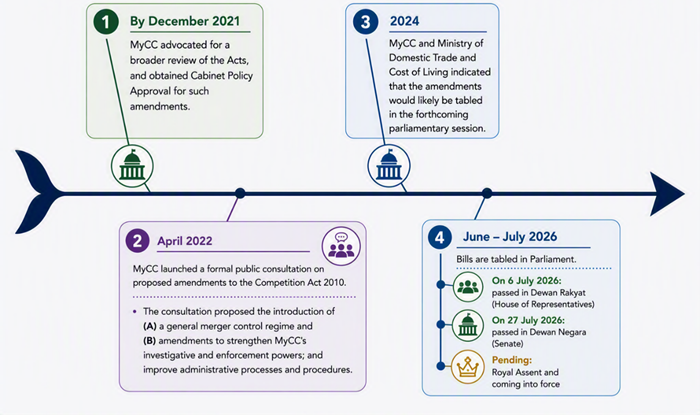
The journey towards reform: Key milestones
Approval from Parliament marks the culmination of a long-awaited legislative reform process and paves the way for a substantial overhaul of Malaysia's competition framework.
In more detail: Practical implications
A brief summary of the key amendments contained in the Bills, and the practical implications for businesses are as follows:
| Key Amendments | Implications |
|
Expansion of Scope of Application The Competition Act 2010 (CA) now applies to "any commercial or economic activity" and not just "any commercial activity". This expands the scope of the CA to apply to a greater range of activities with an impact on competition. |
Any activities which are economic in nature may be caught within the ambit of the CA. This means that entities previously considered to fall outside the CA's reach (such as non-profit organisations, trade associations, government-linked agencies or ministries, or cooperatives) may now be subject to scrutiny if they are engaging in an economic activity. Businesses should audit whether any of their activities previously considered non-commercial could now attract regulatory attention under the expanded scope. |
|
Removal of Distinction between Horizontal and Vertical Agreements The amendments include the removal of the distinction between "horizontal" and "vertical" agreements from the prohibition of anti-competitive agreements. Under the current framework, MyCC is required to establish that an agreement is horizontal in nature before MyCC could rely on Section 4(2), which deems certain categories of horizontal agreements—such as price-fixing, market-sharing, supply control and bid-rigging—to be anti-competitive by object. |
Moving forward, MyCC will no longer need to prove whether an agreement is horizontal or vertical before invoking the deeming provision under Section 4(2). This removes a significant evidential hurdle for MyCC. The consequence however is that the amendment may be interpreted such that even vertical agreements (e.g., supply, distribution, franchise and licensing agreements) involving price-fixing (e.g., resale price maintenance), market-sharing or supply control could be deemed anti-competitive by object, significantly expanding the scope of conduct caught by the deeming provision. Until further guidance is issued by MyCC, it would no longer be prudent to simply assume vertical agreements as inherently lower risk than horizontal agreements. Businesses with existing vertical arrangements should reassess these agreements to evaluate their exposure under the amended framework. |
|
Enhanced Powers of the MyCC The amendments significantly increase MyCC's powers, such that MyCC may:
|
These enhancements have significant practical implications for businesses. In particular: (i) Businesses face greater financial exposure through the imposition of late payment charges on unpaid penalties (ii) Non-compliance with information requests (including those for market reviews) now constitutes a criminal offence (iii) MyCC's ability to recommence investigations after issuing a proposed decision creates the potential for prolonged regulatory uncertainty. Businesses should review their internal processes for responding to MyCC enquiries and ensure timely compliance with all regulatory requests. |
|
Increased Whistleblower Protection The amendments introduce new statutory protections for whistleblowers, including safeguards against the disclosure of their identity and protection from any form of reprisal such as termination of contracts, commencement of unreasonable litigation, withholding of payments, or refusal to enter into subsequent contracts. In addition, MyCC is empowered to grant rewards to informers whose information or assistance leads to the discovery of any infringement or results in any conviction for an offence under the CA. |
These enhanced protections may increase the likelihood of whistleblower complaints being lodged with MyCC, particularly by former employees, disgruntled business partners, or competitors. Businesses should ensure that robust internal reporting mechanisms and appropriate compliance safeguards are in place to mitigate the risk of such complaints arising. |
|
New Settlement Mechanism The amendments allow offenders of the CA to accept settlements proposed by MyCC by admitting liability for infringements, in exchange for MyCC potentially granting a reduction in financial penalties up to 40%. |
This mechanism provides businesses with an additional avenue to reduce exposure to financial penalties where infringement risks are assessed to be high. The potential reduction of up to 40% creates a strong incentive to cooperate with MyCC early in proceedings, which may shift enforcement dynamics in favour of early resolution. Businesses should consider developing internal protocols for evaluating settlement offers at the outset of any investigation, including clear escalation procedures and decision-making frameworks to enable timely and informed responses to any settlement proposals from MyCC. |
|
Revised Framework for Undertakings Under the current framework, MyCC can accept undertakings subject to conditions and is required to close the investigation without making a finding of infringement. The amendments now make clear that MyCC will only accept an undertaking before it has issued a written notice of a proposed decision, effectively narrowing the window for this option. Furthermore, if the enterprise fails to comply with the undertaking, or if information provided to secure the undertaking turns out to be false or misleading in a material way, MyCC is no longer obliged to treat the case as closed and may re-open its investigation. |
Businesses under investigation will need to act swiftly if they wish to offer considered undertakings to MyCC, as the option will no longer be available once MyCC has issued a written notice of its proposed decision. |
|
Leniency Reductions: Coercion as a Differentiating Factor The amendments introduce flexibility for MyCC to vary the percentage of reduction in financial penalties available under the leniency regime based on whether the applicant enterprise has coerced another enterprise into participating in the anti-competitive arrangement. |
The existing Guidelines for Leniency Applications published by MyCC disqualify an enterprise that acts as a ringleader of the cartel, or has taken steps to coerce another enterprise to take part in the cartel activity, from obtaining full immunity from financial penalties. The amendments now allow MyCC the flexibility to grant varying percentages of reduction in financial penalties of less than 100% to enterprises that have coerced another enterprise into participating in the cartel, thus incentivizing more leniency applications. |
|
Removal of finality of CAT decisions The amendments will delete the provision in the CA prescribing decisions of the Competition Appeal Tribunal (CAT) to be "final and binding"; and introduce an appeal route to the High Court which may be used by any persons (including MyCC) who is aggrieved by the decisions of the CAT. |
This allows parties aggrieved by CAT decisions to appeal against such decisions to the High Court, thereby removing the CAT as the final arbiter of infringement decisions under the CA. While this is a positive development for parties seeking to challenge adverse CAT rulings, it also means that MyCC may appeal CAT decisions that are favourable to businesses. This introduces the possibility of prolonged litigation and increased legal costs, even where a business has successfully overturned an infringement finding before the CAT. |
|
New Offence for attempts to obstruct investigations The CA currently prohibits the destruction, concealment, mutilation or alteration of records. The amendments will render any such attempt to do the same as an offence under the CA. |
Businesses should take note that even attempts to destroy, conceal, mutilate or alter records (and not merely the completed acts) now constitute a criminal offence under the CA. In light of this, businesses should review and update their document retention policies, conduct targeted compliance training for employees, and ensure that they understand the serious legal consequences of any attempt to obstruct or interfere with MyCC investigations. |
What about merger control?
Perhaps the most notable absence from the Bills is the proposed introduction of a general merger control regime. Despite having been a central feature of MyCC's 2022 public consultation, the merger control proposals did not ultimately form part of the legislation tabled in Parliament. Consequently, Malaysia continues to be one of the very few jurisdictions worldwide without a general merger control framework, with merger transactions remaining largely outside the scope of competition law regulation.
That said, the Deputy Minister of Domestic Trade and Cost of Living has indicated that merger control reforms are expected to be pursued under the 13th Malaysia Plan (2026-2030), recognising that a merger control regime is a critical component of a complete and modern competition law framework.
Concluding thoughts
The message is clear: Malaysia is moving towards a significantly more robust competition enforcement regime. With broader reach, sharper investigative tools, and new procedural mechanisms at MyCC's disposal, businesses should brace for heightened regulatory scrutiny.
Businesses should take this opportunity to review their competition law compliance frameworks, reassess commercial arrangements and strengthen internal governance processes to ensure they are well-positioned to navigate the evolving regulatory landscape.
* * * * *
Eliza Chow, Associate, has contributed to this legal update.

© 2026 Wong & Partners. All rights reserved. Wong & Partners, member of Baker & McKenzie International. This may qualify as "Attorney Advertising" requiring notice in some jurisdictions. Prior results do not guarantee a similar outcome.