

In brief
Vietnam has issued new rules for determining Vietnamese origin for goods produced and circulated domestically. Decree No. 384/2026/ND-CP ("Decree 384"), dated 9 October 2026, will take effect on 1 January 2027.
The Decree sets out origin criteria, rules on simple processing and requirements for substantiating origin statements. Businesses making statements of Vietnamese origin should review whether their products meet the applicable criteria and whether their records substantiate those statements.
Key takeaways
- For non-wholly obtained goods, Decree 384 provides two alternative criteria: a change in HS classification at the four-digit heading level or Viet Nam Value Content (VVC) of at least 30%, subject to the applicable processing rules.
- For information technology and digital technology goods, VVC includes specified activities carried out in Vietnam, including research and development, design, and technical or software testing linked to product creation.
- Businesses stating Vietnamese origin on labels or related documents and materials will need to retain supporting records and substantiate origin when requested by a competent authority.
- Goods bearing labels that lawfully indicate Vietnamese origin before 1 January 2027 may continue to use those labels until the goods expire.
- Businesses should review their origin assessments, labels and supporting records before the new rules take effect.
In more detail
Domestic origin criteria will complement existing labelling rules
Decree 384 applies to traders engaged in the production and trade of goods circulating domestically. It does not govern origin determination for export and import origin certification purposes, the presentation of labels and their mandatory contents, or product traceability.
Article 47(1) of Decree No. 37/2026/ND-CP ("Decree 37") already requires manufacturers and importers to determine and state origin truthfully and accurately under the applicable origin rules. Decree 384 provides specific criteria for determining Vietnamese origin for goods produced and circulated domestically, while expressly preserving the obligation to comply with labelling and other relevant laws.
Non-wholly obtained goods may qualify under two alternative criteria
Goods will have Vietnamese origin if they meet the wholly obtained criteria in Article 5 or the non-wholly obtained criteria in Article 6 of Decree 384. The wholly obtained categories include crops grown and harvested in Vietnam, and minerals and naturally occurring substances extracted from Vietnamese land, waters, seabed or subsoil.
Non-wholly obtained goods may qualify under either of the following criteria:
- A change in HS classification at the four-digit heading level from non-originating materials used to produce the goods in Vietnam
- VVC of at least 30%, calculated using one of the prescribed formulas.
Decree 384 prescribes VVC formulas and specific rules for technology goods
Decree 384 prescribes the following direct and indirect formulas. Traders choose one formula and apply it for the financial year.
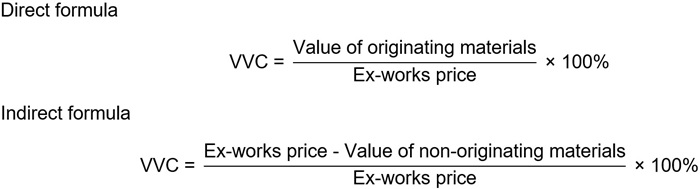
VVC calculations must use the ex-works price and material values defined in Article 3(4)–(5). Packaging materials and containers that form part of the goods are included in VVC. Businesses using this criterion should verify the origin and value of their materials and the ex-works price used in the chosen formula.
For information technology and digital technology goods, VVC includes specified activities that create product value in Vietnam. These include the costs of research and development; design, programming, digitization and automation; and technical testing and software testing linked to the process of creating the product. For purposes of this provision, the simple processing operations listed in Article 7(2) and the factors excluded under Article 8 do not apply.
Simple processing will generally be excluded from origin assessments
Simple processing operations do not use special skills or specialized machinery, production lines or equipment and are not considered when determining Vietnamese origin. Listed operations include simple packaging, labelling, simple assembly and simple testing, whether performed separately or in combination. Article 8 also excludes specified factors, including fuel and energy, tools and moulds, and testing equipment. Article 6(4) provides a specific exception for technology goods.
Ministries may develop specific origin and simple-processing provisions for products with particular characteristics within their remit, where necessary and consistently with the Decree.
Businesses will need to substantiate Vietnamese origin statements
Under the new rules, traders, organizations and individuals stating Vietnamese origin on labels or on documents or materials containing information about the goods will be responsible for the accuracy and truthfulness of that information. They will need to retain supporting records, including input invoices, bills of materials, descriptions of the production process and other relevant documents, in accordance with accounting and archiving laws, and substantiate Vietnamese origin when requested by a competent authority.
If goods produced and circulated domestically are subsequently exported, Vietnamese export origin rules and the importing country's requirements must also be complied with.
Qualifying goods may continue to use existing labels until expiry
Decree 384 will take effect on 1 January 2027. Goods bearing labels that lawfully indicate Vietnamese origin before that date may continue to use those labels until the goods expire.
What businesses should do now
To prepare for the effective date, we recommend that businesses:
- Assess the applicable origin criterion against their materials, HS classifications, manufacturing steps and VVC calculations, including any sector-specific rules.
- Organize supporting records and review statements of Vietnamese origin on labels and related materials.
- Identify goods eligible for the transition rule and monitor relevant implementing or sector-specific provisions.
Please contact our team to discuss how these rules may affect your products and origin statements.
* * * * *
Manh Hung Tran, Partner, Thanh Vinh Nguyen, Partner, and Ngoc Trung Tran, Of Counsel, have co-authored this legal update.

© 2026 BMVN International LLC. All rights reserved. BMVN International LLC is in strategic alliance with Baker & McKenzie (Vietnam) Ltd., a member firm of Baker & McKenzie International, a global law firm with member law firms around the world. In accordance with the common terminology used in professional service organizations, reference to a "partner" means a person who is a partner, or equivalent, in such a law firm. Similarly, reference to an "office" means an office of any such law firm. This may qualify as "Attorney Advertising" requiring notice in some jurisdictions. Prior results do not guarantee a similar outcome.